IRAM
IRAM is an international research institute for radio astronomy. Its overall objective is to explore the universe and to study its origins and evolution.

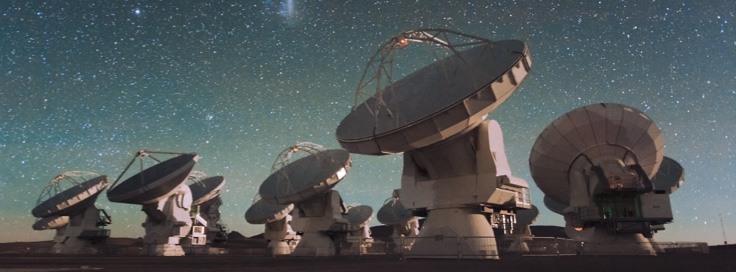
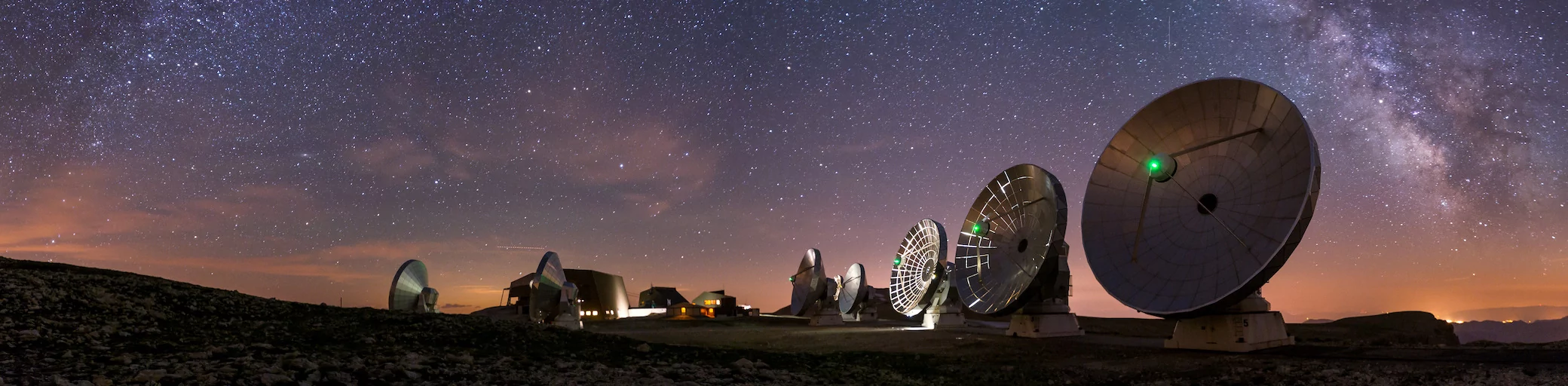
Founded in 1979, IRAM’s headquarters are located in Grenoble. With a staff of more than 120 scientists, engineers, technicians and administrative personnel, IRAM maintains and develops two observatories: the 30-meter telescope located on Pico Veleta near Granada in Spain, and the Plateau de Bure interferometer (an array of six 15-meter telescopes) in the French Alps. Both instruments are prime facilities for radio astronomy and the most powerful observatories today operating at millimetre wavelengths. [...]
October 14, 2011
IRAM ARC Node: Kick-off for ALMA Early Science Observations
ALMA scientific operations have begun on September 30, 2011, when the array started to observe the high-priority projects selected after the Cycle 0 call for proposals. Since the origin of this project in Europe, IRAM has been deeply involved in the ALMA design and construction. Some of the main recent or current contributions of the institute to ALMA include...
Read more
August 8, 2011
The NOEMA Project
On June 28, 2011, an exceptional IRAM Executive Council was held at the Instituto Geogràfico Nacional in Madrid. During this celebratory meeting, a Memorandum of Understanding was signed between the IRAM Partners (CNRS, MPG and IGN) and the institute itself. The signatories expressed their common wish to extend their successful cooperation in running IRAM through the end of 2024. This extension shall include an extension of the Plateau de Bure Interferometer to a facility called the Northern Extended Millimeter Array or NOEMA. The signature of this documents represents a milestone in the history of IRAM...
Read more
August 1, 2011
Kryo 2011: Deadline for registration has been extended!
The deadline for registration to the Meeting on Cryoelectronic Devices has been extended to August 15, 2011. Since 25 years the meeting provides an active discussion platform for the German cryoelectronic research community. Exceptionally, this year the meeting will be held near Grenoble, France. The Grenoble area hosts a large number of active research groups working...
Read more
June 27, 2011
4th Microresonator Workshop: deadline for registration has been extended!
The Deadline for registration to the 4th Workshop on the Physics and Application of Superconducting Microresonators has been extended to July 8, 2011. Superconducting microresonators have recently generated great interest for various applications such as particle and photon detection or in circuit QED and quantum computing. Although...
Read more
April 14, 2011
Meeting on cryoelectronic devices - October 2-4, 2011
In 2011, the yearly meeting on cryoelectronic devices will be organized by IRAM. Since 25 years the meeting provides an active discussion platform for the German cryoelectronic research community. Exceptionally, this year the meeting will be held near Grenoble, France. The Grenoble area hosts a large number of active research groups working on superconducting devices and cryotechnology. These groups are invited to participate...
Read more
April 5, 2011
ALMA Early Science - Proposal Preparation
The first call for proposals for ALMA Early Science (Cycle 0) has been issued on March 30, 2011 with a proposal deadline of June 30, 2011. In order to assist prospective users in the preparation and submission of their proposals, the IRAM ARC node is organizing a workshop on Tuesday May 24, 2011 at IRAM Grenoble.
Read more
March 21, 2011
4th Microresonator Workshop, July 28-29, 2011 in Grenoble
Superconducting microresonators have recently generated great interest for various applications such as particle and photon detection or in circuit QED and quantum computing. Although some of these applications such as kinetic inductance detectors for FIR detection are close to reach system level, many questions remain to be tackled...
Read more
March 14, 2011
IRAM Newsletter Number 76
The new issue of the IRAM Newsletter (number 76) is now online. Since the last issue, the Plateau de Bure interferometer underwent major enhancements. The refurbishment of all antennas with aluminium panels was completed. The LO reference systemwas upgraded from DRO to YIG-based oscillators...
Read more
January 21, 2011
NOEMA sélectionné comme "Equipement d'Excellence"
Valérie Pécresse, ministre de l'Enseignement supérieur et de la recherche, et René Ricol, commissaire général à l'investissement, ont dévoilé hier les projets lauréats de la première vague de l'appel à projets "Équipements d'excellence". Parmi les 52 projets retenus, le projet NOEMA (NOrthern Extended Millimeter Array) de l'IRAM sera doté de 10 millions d'Euros.
Read more
January 18, 2011
6th IRAM 30m Summer School 2011 - Registration is now possible
The next IRAM 30m Summer School will be held from 23 to 30 September 2011 at Pradollano (Sierra Nevada). Applications will be accepted from young scientists with little previous experience in mm-astronomy.
Read more
December 2, 2010
Discovery of an extremely bright dust-enshrouded galaxy in the Early Universe
At the IRAM 30-meter radio telescope, near Granada in Spain, a team of astronomers stumbled upon a totally unexpected celestial source in the course of a program designed to search for debris, in the form of cold dust, left by the formation of planets around nearby stars.
Read more
November 23, 2010
6th IRAM 30m Summer School 2011
The next IRAM 30m Summer School will be held from 23 to 30 September 2011 at Pradollano (Sierra Nevada). The school is aimed at attracting new astrophysicists to current and future single-dish mm-, submm-, and far-infrared telescopes. Applications will be accepted from young scientists with little previous experience in mm-astronomy.
Read more
August 26, 2010
Les étoiles massives font des vagues
En combinant le radiotélescope de 30-mètres de l’IRAM et le télescope Spitzer (NASA), une équipe d’astronomes a pu observer pour la première fois le phénomène des 'vagues' à la surface d'un nuage interstellaire dans la nébuleuse d'Orion.
Read more
April 20, 2010
New Plateau de Bure correlator WideX now operating
We are pleased to announce the availability of WideX for astronomical observations with the Plateau de Bure Interferometer. The new digital processing hardware system executes more than 900 tera multiplications by second to process by correlation the output signals of an interferometer of up to 8 antennas and over a total instantaneous bandwidth of 64 GHz.
Read more
April 12, 2010
Observing with ALMA - Early Science - Registration now open!
From November 29th to December 1st 2010, the IRAM node of the European ALMA Regional Center will organize a practical workshop on how to plan and analyze ALMA Early Science observations. The goal of the workshop is to provide the practical information needed to plan ALMA Early Science observations and answer the first Call for Proposals.
Read more
April 8, 2010
7th IRAM Interferometry School 2010 - Registration is now open!
IRAM will organize this year its 7th Millimeter Interferometry School. These schools are organized every two years since 1998. The 7th school will take place at the IRAM headquarters (Grenoble, France) on October 4-8th, 2010.
Read more
February 11, 2010
Les jeunes galaxies mangent du froid
Une équipe internationale d’astronomes a réussi à montrer que quelques milliards d’années après le Big Bang, lorsque l’Univers n’avait qu’un tiers de son âge actuel, les galaxies massives formant des étoiles contenaient cinq à dix fois plus de gaz froid que celles d’aujourd’hui. Réalisées grâce à l’interféromètre du Plateau de Bure, ces observations de grandes quantités de matière froide, élément clef dans la formation stellaire, expliquent directement les productions gigantesques d’étoiles à ces époques reculées.
Read more
February 8, 2010
Première localisation de l’eau dans un système planétaire en formation
Pour la première fois, des astronomes ont pu localiser où se trouve l’eau dans les disques en rotation autour d’une jeune étoile, semblable à notre soleil. Ces disques, au sein desquels l’on pense que les planètes se forment, sont constitués de gaz et de poussières. La présente analyse montre, de plus, qu’ils peuvent renfermer jusqu’à cent fois la quantité d’eau contenue dans les océans terrestres. Réalisées avec l’interféromètre du Plateau de Bure, l’un des radio observatoires les plus sensibles au monde, les observations permettent ainsi de dévoiler une partie du mystère de l’origine de l’eau dans les systèmes planétaires...
Read more
December 10, 2009
IRAM scales new heights: At 5000 meters altitude, the institute's equipments capture first fringes at ALMA
On November 5th 2009, first fringes on the high-altitude site were obtained with the band 7 receivers, measuring the continuum emission of a bright quasar, 3C454.3. The result testifies for the high quality and performances of IRAM receivers, which exhibit noise figures well below the initial ALMA specifications. With its highly recognized expertise, IRAM is one of the major partners in the construction of ALMA, a giant radio observatory in the Chilean desert...
Read more
November 12, 2009
Mayor of Grenoble and Member of Parliament visit IRAM exhibition stand at the Fête de la Science
The photo shows Grenoble's mayor, Michel Destot, and Geneviève Fioraso, Member of the French Parliament, during their visit of the IRAM exhibition stand at the "Village des Sciences de Grenoble 2009". During 4 days and on the occasion of the French "Fête de la Science", IRAM staff members, astronomers and engineers were explaining IRAM's activities to a general public...
Read more
May 14, 2009
IRAM detectors, tiny but great in space
ESA, the European space agency will soon launch two new scientific satellites for astronomy in a combined mission with its heavy load carrier Ariane 5. Both of them, Planck and Herschel, are equipped with the latest high technology from the Grenoble area. In particular the Herschel Space Observatory (HSO) will embark super-conducting detectors which have been designed and manufactured at the IRAM laboratories.
Read more
February 5, 2009
Infant galaxies: small and hyperactive
When galaxies are born, do their stars form everywhere at once, or only within a small core region? Recent measurements with the Plateau de Bure Interferometer provide the first concrete evidence that star-forming regions in infant galaxies are indeed small - but also hyperactive, producing stars at astonishingly high rates.
Read more
November 25, 2008
First detection of glycolaldehyde outside the Galactic Center
With the IRAM Plateau de Bure interferometer an international team of scientists has detected for the first time outside the Galactic center the simplest of the monosaccharide sugars: glycolaldehyde. The importance of this organic molecule remains in the fact that it can react with propenal to form ribose, a central constituent of RNA, and is, therefore, directly linked to the origin of life...
Read more